The Night My Voice Shook and Everything Changed: Conquering the Fear That Almost Ended My Career
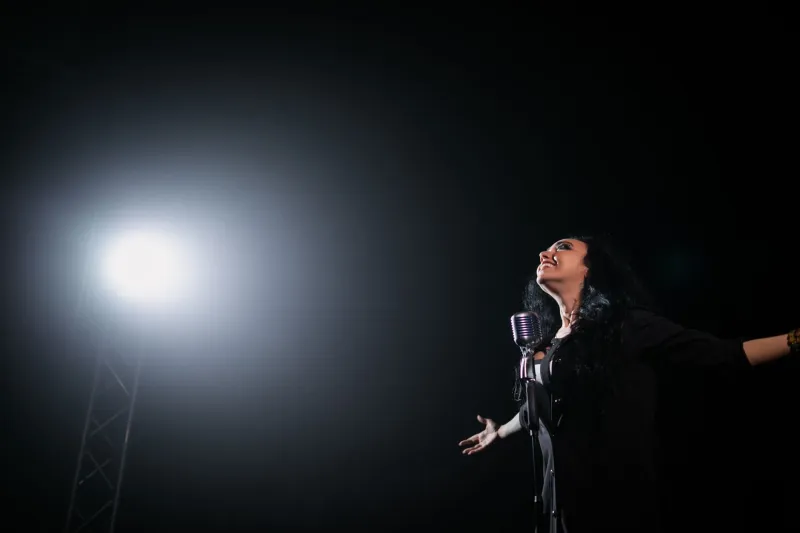
There is a particular kind of silence that exists in the wings of a theater just before you walk out onto the stage. It is not peaceful. It is not meditative. For the better part of a decade, that silence was the loudest, most terrifying sound I had ever encountered. My pulse would thunder in my ears. My palms would grow slick. And my voice — the very instrument I had spent years cultivating — would feel as though it had been swallowed whole by something I could not name.
Performance anxiety is one of those subjects that artists rarely discuss openly, particularly in the early stages of a career. There is an unspoken mythology in entertainment that suggests confidence is a prerequisite for the stage, that those who belong there simply know they belong. I spent years believing that mythology. I spent just as many years feeling like an imposter standing in its shadow.
This is the story of how I dismantled that myth, one breath at a time.
When the Stage Felt Like a Sentence
I remember with uncomfortable clarity the evening that forced me to confront what was really happening inside me. It was an intimate venue — no more than two hundred seats — and the kind of crowd that should have felt welcoming. Supportive faces, familiar music, a program I had rehearsed until the notes lived in my bones. And yet, from the moment I stepped into the spotlight, something inside me fractured.
My first phrase came out thin, unsupported, stripped of the resonance I had worked so hard to develop. I could feel the audience notice. Or perhaps I only imagined they noticed — which, as I would later learn, is precisely the nature of anxiety. It does not require reality to operate. It manufactures its own evidence, constructs its own courtroom, and appoints itself both prosecutor and judge.
I finished the performance. I received applause. I smiled and bowed. And then I walked offstage and sat on a cold concrete floor for twenty minutes, wondering whether I had any business doing this at all.
That night became a turning point, though not because it was my worst performance. It became a turning point because it was the first time I admitted, honestly and without qualification, that something needed to change.
Understanding the Physiology of Fear
The first and perhaps most important realization in my journey was that performance anxiety is not a character flaw. It is a physiological response — the body's ancient alarm system activating in a context it was never designed to navigate. The same adrenaline surge that once helped our ancestors respond to physical danger is the identical mechanism that floods an artist's system before a performance. The body does not distinguish between a predator and an audience. It simply responds.
Once I understood this, I stopped treating anxiety as an enemy and began treating it as information. The racing heart was not evidence of inadequacy. It was energy — raw, unrefined, and entirely available for redirection.
This shift in framing was not immediate, and it was not effortless. It required consistent practice, the guidance of a performance coach, and a willingness to sit with discomfort rather than flee from it. But it was the foundation upon which everything else was built.
The Breathing Practices That Rewired My Nervous System
Among the most practical tools I incorporated into my pre-performance routine were structured breathing techniques, specifically diaphragmatic breathing and what practitioners often refer to as box breathing. The mechanics are straightforward: inhale for a count of four, hold for four, exhale for four, hold again for four. Repeat.
What is less straightforward is the discipline required to actually use these techniques in the moments when anxiety is loudest. The mind under stress resists stillness. It craves action, distraction, escape. Learning to breathe deliberately when every instinct is screaming to pace, to check your phone, to run through your material one more time — that is where the real work lives.
I began incorporating breathwork into my daily routine, not merely as a pre-show ritual but as a consistent practice. Over time, the nervous system begins to associate that pattern of breathing with a state of regulated calm. The body learns a new response. It does not happen overnight, but it does happen.
Rewriting the Internal Narrative
Breathing addresses the body. Mindset addresses the story. And for a long time, the story I was telling myself about performance was one rooted in evaluation rather than expression. I was walking onstage to be judged, to be measured, to prove something. That framing made every performance feel like a trial.
The reframe that changed everything for me was deceptively simple: I am not here to be assessed. I am here to give something.
Performance, at its most essential, is an act of generosity. The artist brings something — a song, a story, an experience — and offers it to the people gathered in the room. When I began approaching the stage with that orientation, the dynamic shifted entirely. My focus moved outward, toward the audience, toward the music, toward the moment itself. The self-consciousness that had been so paralyzing had less room to operate when my attention was genuinely directed elsewhere.
What the Other Side Looks Like
I will not suggest that anxiety has been permanently eradicated from my experience. That would be neither honest nor particularly useful. What I can say is that my relationship with it has been fundamentally transformed. The fear that once threatened to silence me has become, in its own strange way, a collaborator. It sharpens my focus. It reminds me that what I am doing matters. It keeps me present.
The standing ovations, when they come, are not the measure of success I once believed them to be. The measure is something quieter — the moment just before I step into the light when I feel, not fearless exactly, but ready. Grounded. Present in my body and in my purpose.
If you are an artist reading this from the wings of your own stage, whatever form that stage takes, I want you to know that the shaking hands are not the end of the story. They may, in fact, be precisely where the real story begins.